

GH-SAFE project launches to Advance Green Hydrogen Energy Storage for Reliable Electricity in Africa
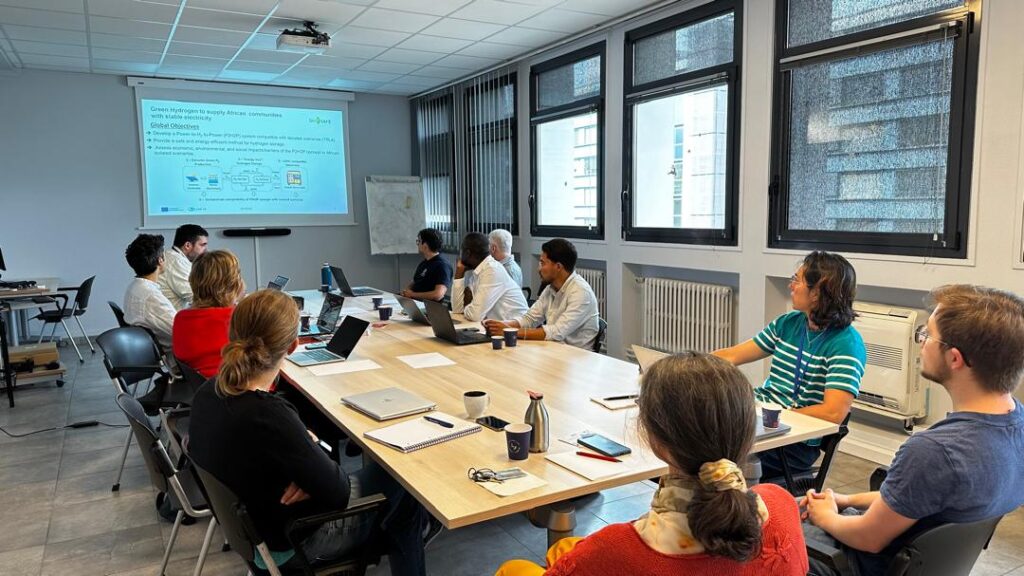
On the 9th and 10th of June 2026, the GH-SAFE (Green Hydrogen to Supply African Communities with Stable Electricity) officially launched its activities with a two-day kick-off meeting in Lyon, France.
Hosted by the French National Centre for Scientific Research (CNRS), the two-day meeting had all partners from Europe and Africa present to officially launch the project’s activities and establish a common roadmap for the next three years. Participants reviewed the project’s objectives, work plan, governance structure, and collaborative mechanisms for the consortium’s technical, environmental, social, and dissemination activities.
GH-SAFE seeks to address the safe, efficient and easy-to-maintain storage of renewable energy and make electricity available when solar power is not in use.
While many African countries possess abundant solar resources, access to stable electricity remains a challenge for millions of people, particularly in rural and off-grid communities. Solar energy offers enormous potential, but its intermittent nature means that energy generated during the day must be stored efficiently for use at night or during periods of low sunlight.
The focus of this 3-year project is to validate and develop a complete power-to-hydrogen-to-power (P2H2P) system that converts surplus solar electricity into green hydrogen, stores it using Liquid Organic Hydrogen Carrier (LOHC) technology, and converts it back into electricity when needed. The project will also explore the use of retrofitted internal combustion engines operating on hydrogen to provide flexible and reliable power generation.
The initiative funded by ANR, FCT, MESRI, MUR, DSTI-NRF, ARI, Projekträger Jülich PTJ, and LGI under the LEAP-SE European Union’s Horizon Europe Program includes a consortium of 12 partners from Europe and Africa with experience and expertise in renewable energy, hydrogen technologies, engineering, environmental assessment, social sciences, and stakeholder engagement.
The consortium includes Instituto Superior Técnico, Research Institute for Solar Energy and New Energies (IRESEN), BluEnergy Revolution, North-West University, South Africa, University of Limpopo, South Africa, Univ. La Réunion, France, Leibniz University Hannover, EnGreen, Senegal, Assane Seck University, Senegal (UASZ), ENSA-École Nationale des Sciences Appliquées d’El Jadida, Morocco (ENSAJ), APODISSI, Nigeria and is led by the French National Centre for Scientific Research (CNRS).
During the kick-off meeting, each partner presented its role within the project and outlined planned contributions across the six main work packages. Discussions focused on the scientific and technical activities required to advance the technology towards validation, as well as the project’s broader ambition to support future replication and uptake of green hydrogen solutions in the African context.
The partners also visited the laboratories of IRCELYON and the facilities of CRMT, a subcontractor of the project. The facility researches hydrogen storage, catalysis, and hydrogen engine development, creating an opportunity for partners to explore the project’s technical infrastructure and strengthen collaboration among the organisations involved.
Beyond technology development, GH-SAFE will also examine the social acceptance, policy considerations, skills development needs, and opportunities for future replication across the continent.
As innovation around energy transition continues to take shape in Africa, GH-SAFE represents an important step towards unlocking the potential of green hydrogen as a long-duration energy storage solution that can help bridge the gap between renewable energy generation and reliable electricity access.